
Posing for Queer Couples: How to Look Natural and Feel Like Yourself in Wedding and Engagement Photos

Updated: Jul 1
Lindsay Ladd is a candid wedding and event photographer based in Baltimore, MD, serving couples across DC, Maryland, Delaware, and all over the US, specializing in LGBTQ+ weddings and internationally recognized for her work with queer couples.
Posing and Why it Feels Awkward
When most people think of a photo session they imagine standing stiffly in front of a camera, not knowing what to do with their hands, and producing photos that feel nothing like them. That overly posed and stiff style is awkward for many people but can be especially unhelpful for queer couples whose relationships don't fit neatly into the traditional frameworks most photographers are familiar with, and what most posing guides are built around.
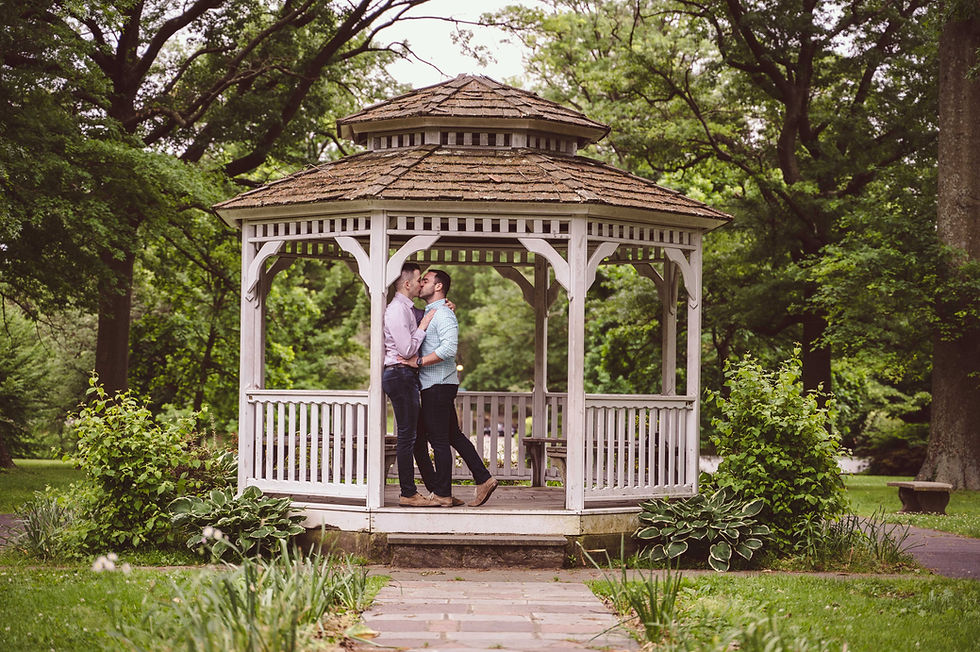
That's not how I, and other candid photographers, actually work: instead of concentrating on the trivial, telling someone where to put their hands and which angle to turn their chin, I focus on the scene as a whole and I give you as a couple an action. Walk across a field, sit on a bench, have a moment together in that gazebo over there, imagine you're greeting your partner after they come home from being away for several weeks.

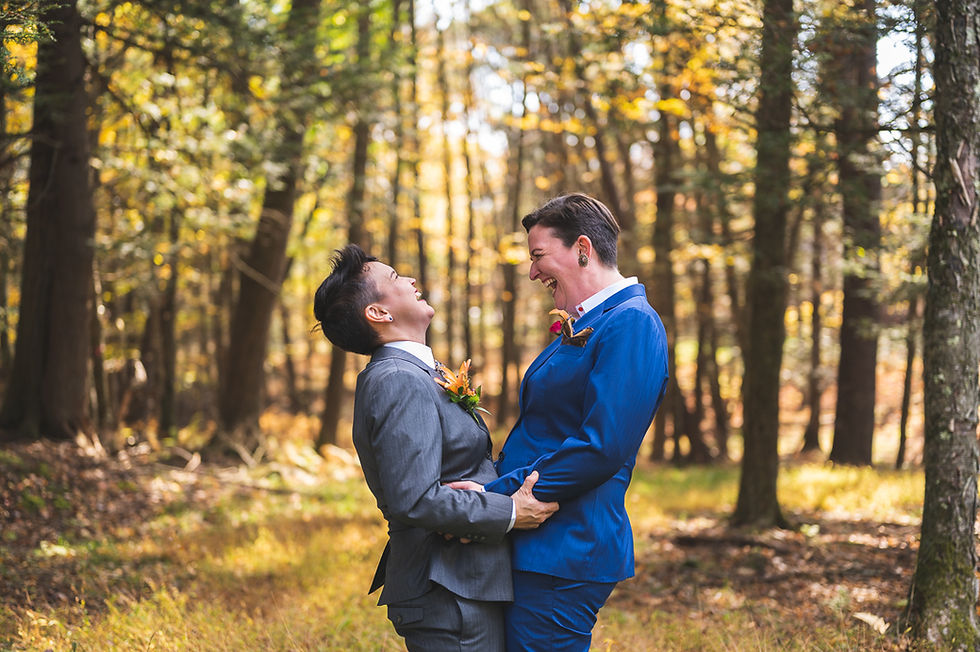
Then, I allow you both to interact naturally with each other, showing your own personalities, and showcasing the dynamic you have as a couple. As the scene unfolds, I photograph you from a distance while you are concentrating on your partner and the moment between you. What comes out of that is something infinitely more beautiful and more true than any formally posed portrait could ever be.
Having an action makes the the process of being photographed infinitely easier, less awkward, and less stressful. You no longer need to watch the camera and photographer; doing a candid shoot allows you to focus on your partner and lose the awkwardness.
This approach works for every couple, but it works especially well for shy or introverted folks and it works well for queer couples, because there's no heteronormative posing template quietly shaping the session. What you get instead is both of you together and your genuine dynamic as a couple.
Why Straight Posing Doesn't Work for Queer Couples
Traditional wedding and engagement photography posing guides were built around a very specific dynamic: one person leads, one person follows, one person is framed as strong and protective, the other as soft and embraced. Those roles were assigned by gender, and the entire visual language of traditional couples photography was constructed around them.
For queer couples, forcing that structure onto your relationship doesn't just feel awkward. It actively misrepresents who you are and what your relationship looks like.
The goal of great couples photography is to capture the genuine dynamic between two people. For queer couples that means a photographer needs to observe how you actually interact, what your energy is with each other and build the session around those real moments rather than imposing a fictional structure over them.

A photographer who defaults to heteronormative posing with queer couples isn't necessarily being malicious. They may simply not have enough experience with LGBTQ+ couples to know another way. But the result is the same: an experience and photos that feel awkward and hollow because the people in them are performing a dynamic that isn't theirs.

A full Breakdown of the Candid Approach
Here's the thing about posing: it works best when both people in the photo know intuitively how to relate to each other within the frame. For couples whose relationship dynamic matches the traditional posing playbook, formal poses can feel relatively natural. For everyone else, and honestly for most people regardless of orientation, being told exactly where to stand and what to do with your body creates a kind of performance anxiety that shows up in the images.

Giving the couple an action to do is different; it gives you something real to focus on, which means your attention shifts away from the camera and toward each other. When your attention is on each other, we as photographers can capture something genuine.
Here are some examples of an action I may give to a couple:
"Go sit on that bench and have a conversation. Tell each other something you're looking forward to about the wedding." This works because it gives both people a genuine emotional focus. The conversation becomes real, the expressions become real, and the connection between you becomes visible in a way that no amount of formal posing can manufacture.

"Take each other's hand and walk down this hill" Walking shots are some of the most natural looking couples portraits that exist, because walking is something humans do without thinking about it. I love starting shoots with this because getting up and moving often helps displace anxieties. Adding in conversation or meaningful glances and the result is effortlessly candid.


"Hang out against this brick wall and have a moment together - lean in and touch each other how you naturally would if you were saying goodnight." This gives couples permission to default to their own natural way of being physically close. However you hold each other when nobody is watching is how you should aim to interact in these moments.
"Go in these interesting tall weeds and reenact when y'all proposed to each other....". Pulling in emotions from past experiences is helpful and it continues to center the image and experience around you both as a couple, focusing that energy towards each other instead of directing it towards the camera.

Posing Ideas for Specific Queer Dynamics
For couples wanting to minimize a height difference: Height differences create natural visual interest and there are endless ways to work with them authentically. Sitting or lying down together equalizes height beautifully. The taller partner leaning slightly against something, like a post of a gazebo (see below). Having the shorter partner walking and leading the taller partner towards the camera is a particularly effective approach. And eye level, close up portraits, where one partner is slightly elevated can create intimacy without making height the dominant visual element.
For polyamorous couples: Group dynamics in photography require a little more intentional composition, but the same principles apply. The goal is to capture the genuine connections within the group rather than to force everyone into a symmetrical lineup. Think about the natural ways your group gravitates toward each other physically and let that be the starting point. There can be a magic in creating triangulations; with arms, with body parts, with whole humans. One of the most recognizable artworks in history, The Last Supper, by Leonardo Da Vinci, uses triangulations to great effect.


What to Wear for Queer Engagement Photos
Wear what feels like you. This sounds obvious but it's worth saying directly because so many couples feel subtle pressure to dress in ways that fit a traditional wedding or engagement photo aesthetic that may have nothing to do with their actual style.
If you both love bold color, wear bold color. If your style is casual and relaxed, dress casually and relaxed. If one or both of you presents in a gender nonconforming way, do that. The clothes and style in your photos should look like the clothes you actually wear, because the goal is for these photos to look like you, not like a generic couples portrait.
One practical note: avoid very busy patterns or large logos, as these can distract from faces and expressions in photos. Avoid a color that exactly matches your skin tone; otherwise the beginning and end of your outfit is lost with your skin. And, most importantly wear something you feel confident and comfortable in - when you feel both of those things, you'll end up radiating in photos.
Before Your Session: How to Prepare
Talk to your photographer about your dynamic in advance. Before your session, share what your relationship dynamic feels like - do you tend to be silly, tender, sarcastic, serious, playful, stoic, etc. Then let you photographer know what you're hoping to capture. If you're nervous about having your photo taken or feeling insecure about something specific, that's also a good thing for the photographer to know. We'll know when to offer encouragement and when to remind you to not hunch over. The more context your photographer has, the better equipped they are to create space for your genuine dynamic to come through and to help you achieve great shots.

Do something together beforehand that puts you both in a good mood Seriously. Go for a walk, grab coffee somewhere you love, listen to music that makes you happy on the drive over. Have a drink. Have a toke. Whatever helps put you at ease and allows your confidence to come forth. Arriving at a session already laughing and relaxed together makes an enormous difference in how quickly you settle into natural, genuine moments in front of the camera.
Give yourself permission to be awkward for the first ten minutes Almost everyone feels slightly awkward at the beginning of a photo session. It's completely normal and it passes quickly. Don't judge the session by how the first ten minutes feel. By the time you've frolicked through a field or sat on a bench for a few minutes chatting, the camera will have faded into the background.
A Note to Other Photographers
If you're a photographer reading this trying to better serve your LGBTQ+ clients, the most important shift you can make is moving from a posing framework to a prompting framework. Stop thinking about where to put people's bodies and start thinking about how to provide actions and prompts that allow them to be themselves. Listen and observe their personalities - adhere to their dynamic and framework, don't force them into yours.
Furthermore, educate yourself on queer relationships and gender nonconformity. Don't assume gendered roles where there are none. Examine your own posing vocabulary for heteronormative assumptions you may not even be aware of. Ask for pronouns. Use gender neutral language as a default. Be genuinely curious about your clients as individuals rather than fitting them into a template.
Your queer clients will feel the difference, they'll trust you more, and it will show in photos you take of them.
Let's Make Something Beautiful Together
Queer love is bold, complex, tender, joyful, and completely its own thing. It deserves to be photographed that way, by someone who sees it clearly and knows how to capture it authentically.
If you're an LGBTQ+ couple planning a wedding or engagement session I would love to hear from you. I photograph couples for engagement shoots locally here in Baltimore, Maryland, and Washington DC, but I also travel the entire United States helping queer couples celebrate their weddings and express their love. Check out real life wedding and engagement photos of gay, lesbian, queer, bi, trans, and polyam couples.
Reach out if you'd like to work together: gingerfoxphoto@gmail.com

